
If you’ve ever wondered how bestselling authors consistently get their books seen—and bought—on Amazon, the answer is usually Amazon Ads. Done right, Amazon Advertising can help even first-time authors gain visibility, build momentum, and turn their books into long-term income streams.
In this guide, I’ll walk you step-by-step through how Amazon Ads work, how to set them up, how to find the right keywords, and most importantly, how to make them profitable.
By the end, you’ll know exactly how to run campaigns that get results—even if you’ve never used Amazon Ads before.
1. Understanding How Amazon Ads Work
Amazon Ads (also called Amazon Marketing Services, or AMS) are pay-per-click (PPC) campaigns. You only pay when someone clicks on your ad—not when they simply see it.
That makes Amazon Ads especially powerful for authors, because they appear right where readers are ready to buy—in search results, product listings, and book detail pages.
There are three main ad types to understand:
-
Sponsored Products: Promote a single book; these appear in search results and on competing book pages.
-
Sponsored Brands: Feature multiple books together with your author name or logo (great for series or imprints).
-
Sponsored Display: Retarget readers who’ve viewed your book—or similar ones—elsewhere on Amazon.
Each ad type serves a purpose, and a strong advertising strategy uses more than one.
2. How the Auction and Bidding System Works
When you launch an ad, you “bid” on keywords or products. Your bid tells Amazon how much you’re willing to pay per click.
If multiple authors bid on the same keyword, Amazon decides whose ad to show based on a combination of bid amount and ad relevance (how closely your ad matches the reader’s search).
For example:
-
If you bid $0.60 and another author bids $0.80, Amazon might still show your ad first if your keywords, book category, and sales history suggest you’re a more relevant match.
-
You only pay one cent higher than the next highest bid, so if your competitor bid $0.40 and you bid $0.60, you’d pay $0.41.
The goal isn’t to bid the highest—it’s to bid smart and optimize over time.
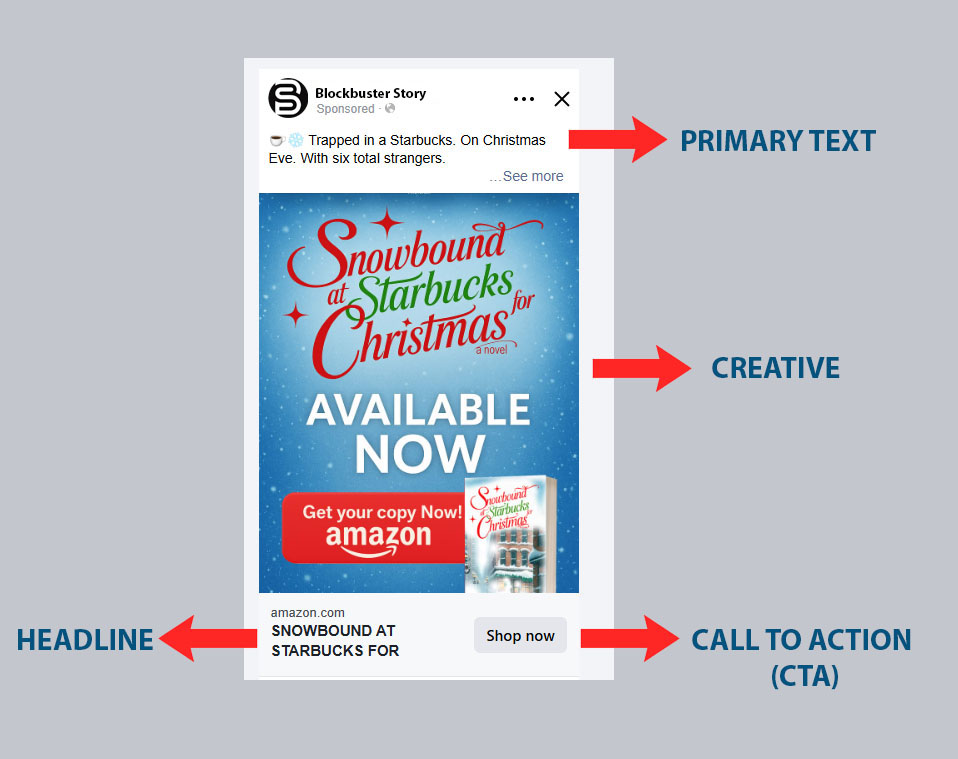
above: components of an amazon ad for books
3. Keyword Research: The Foundation of Every Profitable Campaign
Your ad is only as good as the keywords it targets. Think of keywords as “doorways” through which readers can discover your book.
Here’s how to build a strong keyword list:
-
Start with Amazon’s search bar. Begin typing your genre or theme (“holiday romance,” “time travel thriller”), and note the autocomplete suggestions. These are real reader searches.
-
Study competitors. Look at the “Customers also bought” sections of similar books to identify phrases readers use.
-
Use keyword tools. Tools like Publisher Rocket, Helium 10, or even free options like Google Keyword Planner can reveal search volume and competitiveness.
-
Aim for variety. Mix broad and specific terms:
-
Broad: “romance books,” “thriller novels”
-
Specific: “small-town Christmas romance,” “psychological thriller about revenge”
-
For your first campaign, start with 100–200 keywords, then gradually refine based on performance.
4. Setting Up Your Five Core Campaigns
Every author should run these five foundational campaigns to cover all discovery angles:
1. Auto Campaign (Discovery Mode)
Let Amazon automatically target keywords and products based on your metadata. It’s perfect for gathering data when you’re just starting.
2. Manual Keyword Campaign (Control Mode)
Manually select your keywords based on your research. This gives you maximum control and precision.
3. ASIN Targeting Campaign (Competitor Mode)
Target the product pages of books similar to yours. This places your ad on your competitors’ listings.
4. Brand Campaign (Authority Mode)
If you have multiple books, use a Sponsored Brand campaign to promote your name and your series as a brand.
5. Retargeting Campaign (Reminder Mode)
Sponsored Display ads let you follow readers who’ve viewed your book but didn’t buy, reminding them to return and complete the purchase.
When you set these up, always start with low daily budgets ($3–$10/day) and gradually increase once you see traction.
5. Crafting Effective Ad Copy and Visuals
If you’re using Sponsored Brand or Display ads, visuals matter.
Keep your ad copy short, emotional, and genre-relevant. For example:
-
“Fall in love again this Christmas.”
-
“A thriller so tense, you’ll forget to breathe.”
Use your book cover as the visual anchor—it should instantly convey genre, tone, and professionalism. A weak cover will sabotage even the best ad campaign.
6. Monitoring Your Campaign: What Metrics Mean
Once your ads are running, open your Amazon Ads dashboard regularly. Here’s what to focus on:
-
Impressions: How many times your ad was seen.
-
CTR (Click-Through Rate): Percentage of people who clicked your ad. Anything above 0.3% is solid.
-
ACOS (Advertising Cost of Sales): The key metric—ad spend divided by ad-driven sales. Under 70% is generally profitable for eBooks; under 40% for paperbacks.
-
Conversion Rate: The percentage of clicks that become sales. If it’s low, your cover, blurb, or reviews might need work.
Check these weekly to see what’s working and what’s not.
7. Troubleshooting Underperforming Ads
If your campaigns aren’t performing, don’t scrap them—diagnose the problem.
Low impressions?
-
Increase your bid slightly.
-
Broaden your keywords.
-
Check that your book is in the right category.
Clicks but no sales?
-
Your cover or blurb may not convert. Test a new version.
-
Verify your price point matches your genre norms.
High ACOS?
-
Pause keywords that cost too much and don’t convert.
-
Shift your budget toward high-performing terms.
Optimization is a cycle—test, tweak, repeat.
8. Scaling Your Campaigns
Once you find a formula that works, scale gradually. Double your budget on winning campaigns, test new related keywords, and expand to other ad types.
Authors who commit to continuous optimization often see Amazon Ads become a predictable revenue engine, not a gamble.
9. The Power of Patience and Data
Amazon Ads are a long game. You won’t see results overnight, but data compounds. Each week you’ll understand your readers better: what they click, what they buy, and what hooks them emotionally.
The authors who win on Amazon Ads are those who treat it like a learning process, not a one-time setup.
Final Thoughts
Mastering Amazon Ads takes time—but once you do, you’ll have the power to drive your own visibility, rather than hoping for it.
You now have everything you need to create, analyze, and optimize profitable ad campaigns from day one.
👉 Before you launch your ads, make sure your book looks the part. Learn how to design a book cover that sells on Amazon—the first step to higher click-throughs and more sales.