

If you’ve ever published a book on Amazon KDP, you’ve probably learned this lesson the hard way: a great book doesn’t automatically mean great sales. You can have a stunning cover, a gripping story, and an optimized description, but if readers never find your book in the first place, none of that matters.
That’s where KDP keyword research comes in. It’s the foundation of visibility—the single most important skill that separates successful self-publishers from the thousands of titles lost in Amazon’s endless catalog.
In this guide, we’ll break down how to find profitable keywords that actually drive sales, reveal the strategies top authors use to earn consistent royalties, and show you how to take the guesswork out of keyword discovery for good.
Why Keyword Research Matters So Much for KDP
When readers open Amazon, they don’t type “random indie author.” They type specific phrases:
“romantic Christmas books,” “mindfulness for beginners,” “kids book about kindness.”
Each of those phrases is a keyword, and Amazon’s algorithm uses them to decide which books appear first. If your book doesn’t target the right keywords, it won’t show up—no matter how good it is.
Think of keyword research as the GPS for your publishing journey. It tells Amazon exactly where your book belongs, connects you with your ideal readers, and boosts your visibility in both search results and “Customers Also Bought” recommendations.
Successful KDP authors understand this. They spend just as much time researching keywords as they do writing chapters. It’s not gaming the system—it’s understanding your audience.
The Golden Rule of KDP Keyword Research: Intent + Opportunity
The most profitable keywords hit the sweet spot between reader intent and low competition.
-
Reader intent means the keyword reflects what people are actually searching for and willing to buy.
-
Low competition means not every bestseller is already targeting it.
If a keyword has thousands of monthly searches but relatively few top-ranking books, you’ve found gold.
For example, “cozy winter romance” might be more profitable than “holiday romance” because it’s narrower but still widely searched.
Step 1: Start With Amazon’s Search Bar
Amazon itself is one of the most powerful keyword tools you’ll ever use—because it shows you what readers are typing right now.
Start by typing a broad phrase related to your book. Amazon will instantly generate a dropdown of autocomplete suggestions. Those are live search terms being entered by real customers.
Type “self help” and you might see:
-
self help for anxiety
-
self help for overthinkers
-
self help for men
-
self help journal

Each of these is a ready-made keyword idea. Add them to your research list.
For fiction, try typing genre-related keywords: “small town,” “enemies to lovers,” “Christmas mystery,” “paranormal academy.” You’ll start spotting patterns that point directly to what readers want next.
Step 2: Study the Competition
Now that you’ve got a list of potential keywords, it’s time to analyze which ones are actually profitable.
Search each keyword on Amazon and look at the first page of results. Pay attention to:
-
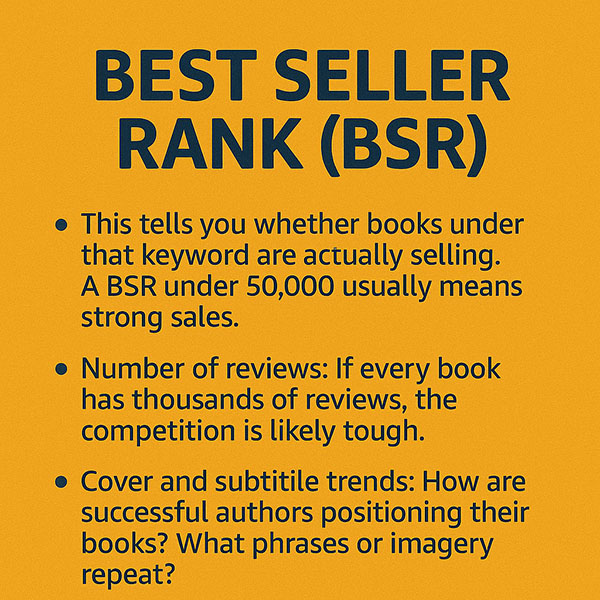
Best Seller Rank (BSR): This tells you whether books under that keyword are actually selling. A BSR under 50,000 usually means strong sales.
-
Number of reviews: If every book has thousands of reviews, the competition is likely tough.
-
Cover and subtitle trends: How are successful authors positioning their books? What phrases or imagery repeat?
If you notice that a keyword produces well-selling books but the competition isn’t saturated, that’s your target.
For example, “romantic suspense for women” might yield books with strong BSRs but fewer than 100 reviews—perfect for a new author to enter.
Step 3: Use a Keyword Research Tool to Find Hidden Gems
This is where the pros separate themselves from the amateurs. Instead of guessing, experienced publishers rely on data-driven tools that pull directly from Amazon’s ecosystem.
Three of the best options include:
-
Publisher Rocket – Shows search volume, competition score, and estimated monthly earnings.
-
Book Bolt – Combines keyword research with low-content book ideas.
-
KDSpy – Chrome extension that scans Amazon search results for profitability data in seconds.
Using these tools, you can uncover high-value keywords you’d never find manually—often with low competition and high sales potential.
Example: Publisher Rocket might show that “gratitude journal for teens” has a monthly search volume of 3,000, low competition, and $1,500 in estimated earnings. That’s a keyword worth building a book around.
Step 4: Apply Keywords Strategically in Your Book Listing
Once you’ve identified your seven strongest keywords, it’s time to apply them across your KDP listing. But placement matters.
Here’s where to use them effectively:
-
Title and Subtitle: Integrate keywords naturally while keeping the language reader-friendly.
Example: Mindful Living: Simple Self-Help for Stress, Anxiety, and Overthinking
-
Book Description: Sprinkle 2–3 of your primary keywords naturally throughout your blurb.
-
Backend Keywords: Use all seven fields in your KDP dashboard—no need to repeat words already in your title or subtitle.
Avoid keyword stuffing. Amazon’s algorithm is smart enough to recognize relevance without repetition. The goal is clarity and precision, not spam.
Step 5: Track and Adjust Over Time
Keyword performance isn’t static. As trends change, certain phrases may lose traction while new opportunities emerge.
Set a reminder to check your keywords every 60–90 days. Use your KDP dashboard to see which books are climbing or dropping in rank. If sales slow, test new keywords or experiment with fresh categories.
Remember: KDP keyword research isn’t a one-time chore—it’s an ongoing process of optimization.
Bonus Tip: Combine Strong Keywords With Strong Packaging
Keywords bring readers to your product page. But what keeps them there—and convinces them to buy—is your cover design and book description.
If your book isn’t converting after good keyword placement, your presentation might need an upgrade.
That’s where professional help can make all the difference. At Vincent & Friends Creative & Literary Packaging Services, we specialize in:
-
Custom book cover design for both eBook and print (optimized for Amazon KDP).
-
Full publishing support—from story development to formatting and marketing.
When you pair professional packaging with smart keyword targeting, you dramatically increase your chances of turning browsers into buyers.
Explore our book cover design packages or learn how our publishing services can help you get your next title live and ranking faster.
Real-World Example: Turning Keywords Into Cash Flow
Consider a self-publisher who writes short self-help books. Instead of targeting “self help,” they focus on long-tail keywords like “self help for overthinkers” and “emotional healing workbook.”
By optimizing their title, description, and backend metadata around these phrases, their books start ranking on the first page for multiple searches. Within three months, they’re seeing steady royalties and multiple books generating $1,000+ each month—all because they learned how to speak Amazon’s language.
That’s the magic of KDP keyword research done right.
Key Takeaway
Keyword research isn’t glamorous. It doesn’t involve coffee-shop writing sessions or creative breakthroughs. But it’s the most powerful marketing skill an indie author can learn.
When you understand what readers are searching for—and align your book’s presentation to meet that demand—you stop hoping for sales and start engineering them.
By using Amazon’s data, analyzing the competition, leveraging the right software, and pairing your findings with a professional cover and description, you’ll put your books in front of the readers who are ready to buy.
Start applying these strategies today—and watch your next KDP launch rise higher, faster, and stronger.